
Formula 1 Betting in New Zealand: How the 2026 Season Actually Works for Kiwi Punters
 Available in US
Current as of 26 October 2026 · Verified against TAB NZ’s own published terms and the Racing Industry Act 2020 framework.

Table of Contents
- How Formula 1 Betting Works from a New Zealand Account
- The Ten Platforms Reviewed Against the New Zealand Market
- What the New Zealand Market Is in 2026
- The Legal Frame Around F1 Betting in New Zealand
- Responsible Gambling Tools and Where Help Is Available
- F1 Betting Markets and What Each One Costs
- Predictions, Tips, and the Limits of Forecasting F1
- The Range of F1 Markets Available to a New Zealand Bettor
- TAB NZ — What the Two New Zealand-Licensed Brands Actually Offer
- Roobet — What the Curaçao-Licensed Brand Carries on F1
- Spinbara — First-Deposit Bonuses and Crypto Welcome Packages
- Sportaza — Cash Out, Bet Builder, Asian Lines
- Thunderpick — Esports-First with a Sportsbook Attached
- Rooster.bet — Six Odds Formats and a Predictions Tab
- Glorion — A Wider Catalogue Including Virtuals and Entertainment
- RoyalistPlay — Live Betting with a Tobique Licence
- BetAlright — A Tighter Catalogue of Major Codes
- What the Calculation Says About a Two-Way Market at $1.90
- Frequently Asked Questions
How Formula 1 Betting Works from a New Zealand Account
A Formula 1 bet is the same kind of object as any other sports bet: a stake against a price, settled against an outcome decided on track. What changes between a casual Grand Prix punt and the season-long markets is the length of the run and the number of variables in play. A race-day market settles on Sunday evening New Zealand time. A Drivers’ Championship market runs from the lights out in Melbourne in March to the chequered flag in Abu Dhabi in December, and only the last of twenty-three counting rounds decides it.
The mechanics on the bet slip are familiar from any code. Pick a selection, enter a stake in dollars, the slip multiplies the stake by the decimal odds shown, and that figure is the return if the bet wins — stake included. A $10 bet at $3.50 returns $35, which is $25 of profit over and above the original stake. A multi is the same mechanic stacked: each leg’s odds multiply into one combined price, and every leg has to win for the multi to pay out. Same Race Multis work the same way but pull the legs from a single Grand Prix — race winner combined with fastest lap, for example, or a podium finish paired with a head-to-head matchup.

What Formula 1 betting is not, despite how the marketing sometimes reads, is a market where knowledge of the sport translates into easy profit. The bookmaker’s margin sits inside every price on the slip, and the more exotic the market — fastest lap, qualifying head-to-head, the safety-car band on a given lap range — the wider that margin tends to be. A bettor who only ever takes race winners at $2.00 about the favourite pays a quieter tax than one who collects novelty markets for fun. Both pay it. The difference is whether the reader knows it is there.
The other thing the bet slip cannot show is the conditions attached to a promotion. A “bonus bet” lands as a token in the account; the reader still has to meet a turnover requirement before any winnings turn into withdrawable cash. A boosted price is real money at an inflated price for a short window; the terms usually say no cash-out, no multi combination, and sometimes a cap on the maximum stake that qualifies. None of those conditions sit on the slip. They live on the promotions page of the operator running them, and reading them before placing the bet is the difference between treating a bonus as a small edge and treating it as a loss in slow motion.
The Ten Platforms Reviewed Against the New Zealand Market
The ten platforms below cover Formula 1 betting in New Zealand for the 2026 season. Two of them are the only lawful options for a New Zealand resident. The other eight are international brands New Zealand readers will encounter in search results, comparison sites and affiliate promotions; none of them holds a licence to take bets from people in New Zealand.
The order is not a ranking of “best” — it cannot be, because the two TAB NZ brands operate under a regime the offshore brands do not have access to, and the offshore brands operate under regimes that do not protect a New Zealand customer. The order walks from the lawful option outward, so the reader can see the comparison before deciding how far from the regulated market they want to bet. The last column of the comparison table summarises what each operator’s own terms state on the key the reader is most likely to check first.
| Platform | New Zealand status | What the operator’s own terms state |
|---|---|---|
| TAB | TAB NZ brand (one of two) | Racing and sports betting only; 18+; fixed odds and tote; verified NZ address required |
| Betcha | TAB NZ brand (one of two) | Racing and sports betting only; 18+; fixed odds and tote; published by Entain NZ |
| Roobet | Not licensed in New Zealand | Curaçao licence (OGL/2024/687/0427); 18+; sportsbook covers soccer, basketball, tennis, esports and more |
| Spinbara | Not licensed in New Zealand | No licence applicable in New Zealand; first-deposit and crypto welcome bonuses advertised |
| Sportaza | Not licensed in New Zealand | Anjouan licence (ALSI-202606064-FI2); cash out, Bet Builder, Asian lines, interval markets |
| Thunderpick | Not licensed in New Zealand | Curaçao licence (OGL/2024/677/0722); esports-first with sportsbook and casino |
| Rooster.bet | Not licensed in New Zealand | Tobique e-gaming licence (No. 0000002); six odds formats; Live and E-sports sections |
| Glorion | Not licensed in New Zealand | No licence applicable in New Zealand; pre-match, live, virtuals and esports |
| RoyalistPlay | Not licensed in New Zealand | Tobique e-gaming licence (No. 0000002); live betting, sports promos and Predictions tab |
| BetAlright | Not licensed in New Zealand | No licence applicable in New Zealand; football, tennis, NBA, NHL and live betting |
The table is a snapshot of what the brands themselves publish. Where the column reads “Not licensed in New Zealand”, that line is not a mark against the brand’s quality — many of these platforms run large international books with hundreds of thousands of active customers. It is a statement of fact about who is allowed to take a bet from a person sitting in Auckland, Wellington or Christchurch, and about where a complaint goes if the offshore brand does not pay out.
What the offshore brands have that TAB NZ does not
The eight unlicensed brands carry product features that the New Zealand-licensed pair does not currently match in the same shape. Cash-out, where the operator offers to buy a bet back at a derived price mid-event, is standard on Sportaza, Rooster.bet and RoyalistPlay. Bet Builder, which assembles a same-event multi from markets the operator is not able to normally let a punter combine, is documented on Sportaza. Interval markets — bets on what happens in the course of the next 5, 10 or 15 minutes of a Grand Prix — are listed on Sportaza and a handful of the others. Rooster.bet shows odds in six formats; the others default to decimal but allow switching.
These features are real. They are also the reason an offshore brand is worth comparing: the product is wider, the markets are deeper, and the promotions are louder. The legal frame is the reason this page keeps the comparison honest: a wider product sitting behind a Curaçao or Anjouan licence offers no recourse in New Zealand if the operator declines a withdrawal, and no New Zealand regulator can compel a payout.
What TAB NZ has that the offshore brands do not
The legal frame is the product TAB NZ sells, in a sense. A bet struck with TAB NZ is overseen by the Department of Internal Affairs under the Racing Industry Act 2020, and the betting prohibition under section 74AAA of that Act is what keeps the offshore competition from advertising inside New Zealand. TAB NZ pays a Problem Gambling Levy of 0.74% of its betting revenue — that money funds the Gambling Helpline and Safer Gambling Aotearoa. TAB NZ’s app carries in-built deposit limits, time-out tools and self-exclusion that apply across both TAB NZ brands. The exclusion register inside the app is the one a New Zealand customer can actually depend on to be honoured, because the operator honouring it is the same one the regulator can hold to account.
This is what an offshore brand’s Curaçao or Anjouan paperwork does not give a New Zealand customer: a regulator who can compel a payout, a self-exclusion register the New Zealand-licensed brands share, and a complaints path that ends somewhere a New Zealand reader can write to.
What the New Zealand Market Is in 2026
Formula 1 in 2026 is a 23-round World Championship: the longest calendar in the sport’s history before the 2026 season, running from the Australian Grand Prix at Albert Park in Melbourne on 8 March 2026 to the Abu Dhabi Grand Prix at Yas Marina on 6 December 2026. There were originally 24 races scheduled; the Saudi Arabian Grand Prix was cancelled, which is why the count sits at 23, for this reason. Eleven teams line up on the grid, the largest entry since the early 2010s.
The technical package changed materially for this season. The MGU-H has been removed, the MGU-K output has jumped from 160 bhp to 470 bhp (350 kW), and DRS has been replaced with active aerodynamics — the headline change that determines how overtaking is supposed to work in 2026 and for this reason how the race-day betting prices set up. The team cost cap has risen from $135M to $215M, which is the budget envelope each constructor must keep its spending inside for the season and a separate input into the Drivers’ Championship market because wealthier teams can spend more on development over the course of the year.
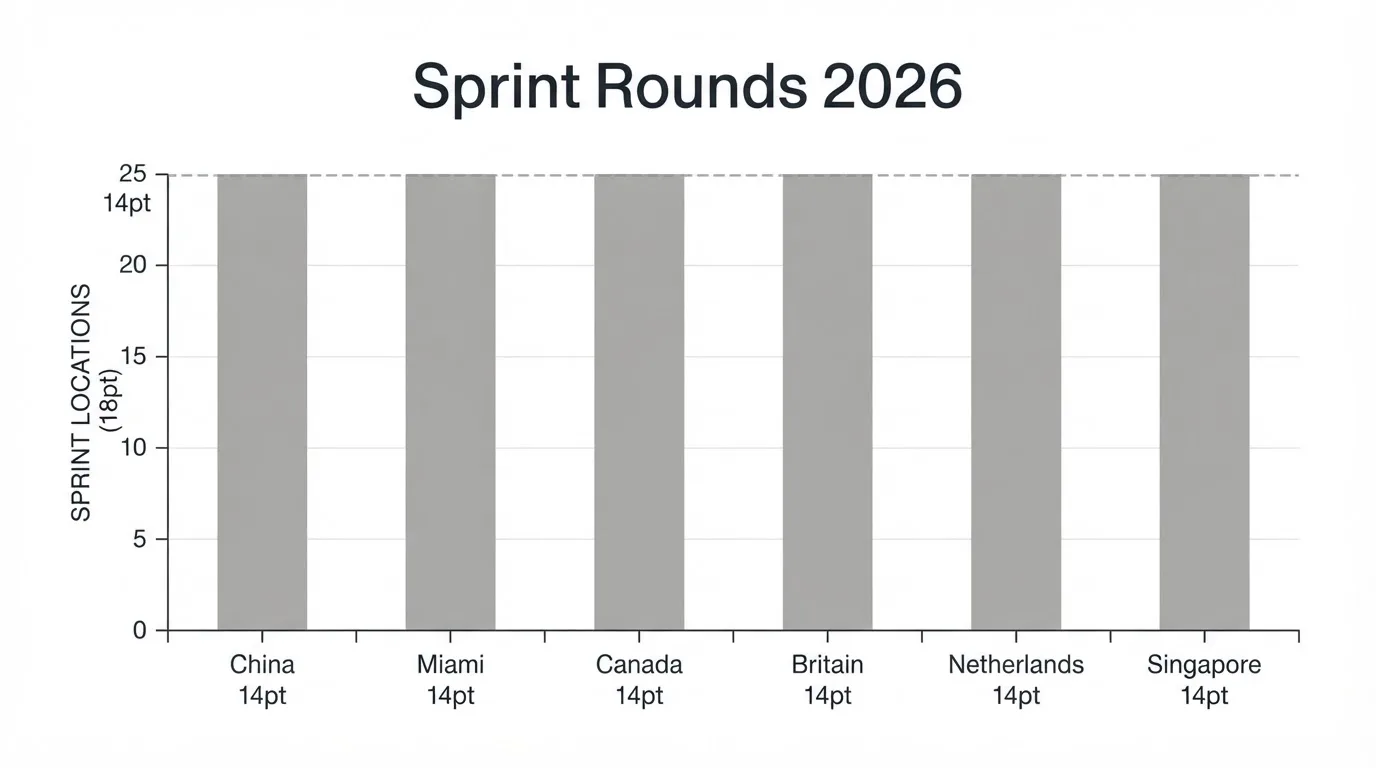
Six of the twenty-three rounds are sprint weekends: China, Miami, Canada, Britain, the Netherlands and Singapore. Sprint weekends carry a separate qualifying session on Saturday and a shorter race on Saturday afternoon; the sprint result pays out separately, the sprint qualifying session is its own market, and a Same Race Multi that bundles a sprint result with a Sunday result pays both legs on a single ticket. Lando Norris enters the 2026 season as the reigning Drivers’ Champion.
What the calendar means for betting
A 23-round season with six sprint weekends is a long season, which is what makes the championship markets the centre of gravity for serious F1 bettors. The race-winner market settles on a Sunday afternoon; the championship market does not settle until the final round in Abu Dhabi. That is nine months of price movement, retirements, regulation-driven upgrades, and mid-season driver changes — any one of which can flip a championship market from “comforter” to “dead” in a single weekend.
The sprint weekends complicate the per-race picture without simplifying the championship picture. A sprint race adds one more result to settle on a Saturday; a sprint format changes how the parc fermé rules apply; a sprint result can hand a driver a grid penalty that washes into the Sunday race. For a bettor who treats F1 as a Saturday-Sunday hobby, the sprint rounds are an extra source of markets, not a complication of the markets they were already taking.
What the rule changes mean for odds
Active aerodynamics replaces DRS as the primary overtaking aid. DRS was a driver-activated flap that opened a rear wing element when a following car got within one second of the car ahead at a designated zone; active aerodynamics is a system that can change the shape of aerodynamic surfaces under driver control across more of the lap. The two systems create different racing dynamics, which create different betting dynamics. A punter who built a DRS-era model for the overtake count market has to rebuild it. A bookmaker who priced the overtake count market on DRS-era averages has to reset those margins — and the reset is rarely to the punter’s advantage.
The cost cap change is a smaller signal in any given race but a larger signal in the championship markets. More money to spend over a season widens the gap between the well-resourced teams and the rest, which over twenty-three rounds widens the points gap at the front of the field. Whether the on-track product delivers on the promise of closer racing is a separate question from whether the championship market tightens. The cost cap is the latter lever.
The Legal Frame Around F1 Betting in New Zealand
The Racing Industry Amendment Act 2025 inserted section 74AAA into the Racing Industry Act 2020, and the change took effect on 28 June 2025. The plain reading is that no person other than TAB NZ may offer racing betting, sports betting or other racing or sports betting to a person in New Zealand, regardless of where that person is resident or incorporated. The Department of Internal Affairs told providers serving New Zealand to withdraw with immediate effect when the section came into force. There is no licence to apply for and no licence register for bookmakers, because there is only one lawful provider.
TAB NZ is the holder of the racing and sports-betting monopoly. Entain runs the TAB business under a 25-year agreement signed in 2023, with a 50/50 share of gross profits, at least $150m a year going to TAB NZ for the first five years, and a one-off $100m payment Entain pledged to the racing sector at signing. Tab NZ’s two online brands are TAB and Betcha — one operator group, not two rivals. Betcha, run by Entain New Zealand Limited, was first released on the New Zealand App Store on 6 August 2024. TAB’s racing and sports app was first released on 8 September 2014 under the seller name New Zealand Racing Board.
The Online Casino Gambling Act 2026 licenses online casino gambling only. It does not change the betting monopoly. TAB New Zealand winning the right to apply for a casino licence under that Act does not extend the racing or sports-betting monopoly to casino products, and the page does not conflate the two.
What the law means for the player
Section 19(4) of the Gambling Act 2003, inserted in 2025, says an individual may not be convicted for placing a bet with an offshore betting operator in breach of section 74AAA. No source states a penalty for a player. New Zealand does not block bookmaker websites, and there is no payment-blocking order or bank obligation under the framework. The law targets the operator, not the customer, and the Department of Internal Affairs warns players of the risks rather than prosecuting them.
What DIA’s stated risks amount to is this: an overseas operator may sit in a jurisdiction with minimal consumer safeguards, may not return unspent credits, and may not pay out large wins. The DIA warning is not a forecast of what any one operator will do. It is a description of the worst case that the absence of a New Zealand regulator leaves open. An offshore brand operating under a Curaçao, Anjouan or Tobique licence is answerable to that licence’s regulator, not to DIA, and the process for a New Zealand complainant runs in that jurisdiction, in that language, on that timeline.
What the law does not do
The law does not give a per-bet cap, does not set a maximum stake, does not restrict in-play betting by statute, does not name which events may or may not be bet on, and does not regulate the marketing of betting offers. Limits are TAB NZ’s own terms. The market list of TAB NZ comes from its own published betting rules. The Advertising Standards Authority’s Gambling Advertising Code applies to betting advertisements: ads must not target children (under 14) or young people (14 to under 18), judged by context, appeal and expected audience (where accurate data exists, 25% or more of the audience counts as significant), must not encourage harm, and must be truthful with terms available. There is no New Zealand equivalent of a “whistle-to-whistle” advertising ban.
Nothing in the framework rules on crypto deposits, on VPN use, or on payment instruments more granularly than TAB NZ’s own deposit-methods page. Nothing compels a bank to block a payment to an offshore operator. The Offshore point-of-consumption charge that once applied to offshore racing and sports bets ceased on 30 June 2026, but a duty being payable never made an offer lawful — overseas operators supplying New Zealand residents still pay online gambling duty (12% of profits since 1 July 2024, moving to 16% from 1 January 2027), and that duty is not a substitute for the New Zealand licence that none of them hold.
Greyhound racing and the closing calendar
Greyhound racing is closing in stages from 1 August 2026. From that date, offshore operators may not take bets on greyhound races either. The Racing Industry Act framework treats greyhound racing as a racing code for the purposes of section 74AAA, and the section 74AAA prohibition catches it once the code closes. A bettor who used to take a greyhound place bet with an offshore brand for an after-work punt will not be able to do so from August onwards; the legal frame closes the door on that market for everyone, not just for the New Zealand-licensed brands.
Responsible Gambling Tools and Where Help Is Available
The harm-minimisation tools a New Zealand punter can actually use live inside the TAB NZ apps. TAB NZ lists deposit limits, time-outs and self-exclusion in its racing and sports app, and the same exclusion extends across both TAB NZ brands — a self-exclusion set on TAB applies to Betcha as well, because both apps run off the one TAB NZ account framework.
The Gambling Helpline is free and runs 0800 654 655, with a text line on 8006. Safer Gambling Aotearoa is the public-facing service funded by the Problem Gambling Levy TAB NZ pays. The levy sits at 0.74% in force from 1 July 2025 to 30 June 2028. None of these tools reaches a bettor who has placed a bet with an offshore brand: the offshore brand’s self-exclusion applies inside its own platform only, and the New Zealand harm-minimisation framework does not extend across the border.
The age for betting in New Zealand is 18, set under section 89 of the Racing Industry Act 2020; betting under 18 is an offence. Land-based casinos set their age at 20 — the two thresholds exist for a reason and the page does not merge them. TAB NZ accounts require a verified New Zealand address and ID before a withdrawal is permitted; that verification step is what makes the harm-minimisation tools and the levy funding real, because the operator knows who the customer is.
For a reader who is worried about their own betting or someone else’s, the practical first step is the Gambling Helpline. The free service handles calls and texts, and Safer Gambling Aotearoa publishes advice on the warning signs. The exclusions and limits inside the TAB NZ apps are the practical second step: setting a deposit limit before the next race weekend costs nothing and does not require a phone call. The two together — talking to the helpline and using the in-app tools — is what the framework is set up to support.
F1 Betting Markets and What Each One Costs
A race-day card carries the markets most bettors already know: race winner, podium finish (top three), fastest lap, pole position, and head-to-head matchups between named drivers. The market depth grows from there. Qualifying markets settle on Saturday afternoon and run their own prices. Practice markets exist on some platforms but settle on relative performance rather than absolute time, which is what makes them difficult to price for the bookmaker as well as the bettor.
The championship markets are season-long. Drivers’ Championship pays out on the driver with the most points at the end of the final round. Constructors’ Championship pays on the team with the most combined points from both drivers. Both are settled after the chequered flag in Abu Dhabi, and both carry a much wider margin on each named driver than a single-race market, because the bookmaker is hedging across nine months of price movement and many possible points scenarios.
The novelty markets are where the margin tends to widen. Fastest lap, safety-car laps, retirements, margin of victory, the order in which named drivers finish — each is a smaller market with fewer reference points for the bookmaker to model, and the price a punter sees carries a wider cut for the operator as a result. None of that is a reason to avoid the novelty markets; it is a reason to know what the bet is paying for.
Margin, as it actually shows up
The bookmaker’s margin is the cut the operator keeps of every dollar staked on a market. It sits inside the prices, invisible on the slip, and shows up in two ways: a single favourite at $1.90 about a 50/50 outcome is already charging the punter for the privilege of betting, and a market where every runner pays $4.50 for a ten-runner field is charging a wider cut than one where the favourite pays $3.00 and the longshots pay $30.
For a two-way market at $1.90 about each side, the payout share is one over the sum of the reciprocal odds — that is, one divided by (1 ÷ 1.90 plus 1 ÷ 1.90), which equals 0.95. The margin is one minus the payout share: five cents in every dollar staked is the operator’s cut on this market, before any promotion adjusts it. A punter backing one side at $1.90 expects to win half the time at fair odds of $2.00; the five-cent gap is what the operator keeps.
That is the arithmetic on a balanced two-way example. Real F1 markets are not two-way, and the prices are not balanced. A race-winner market with twenty drivers is a twenty-way market, and the margin across twenty legs is harder to eyeball but easy enough to check: turn each price into its implied probability (one divided by the decimal odds), add the implied probabilities together, and the sum is the market’s overround. A sum of 1.05 means a 5% margin; a sum of 1.08 means an 8% margin. The wider the sum above 1.00, the wider the cut. The punter who reads overround learns to spot the markets where the book is charging most.
The band the page reports for a $1.90 / $1.90 two-way illustration is 5% margin, with the explicit condition that this is the figure for a balanced two-way market at those prices — not the figure for a race-winner market, not the figure for a championship market, and not the figure for any of the novelty markets. Real margins on a real F1 race card sit wider than 5% on most selections.
Why the margin matters more than the headline price
A punter who chases the highest price on a market without checking the market’s margin is being moved around by the loudest promotion on the page. A boosted price on a race winner at the front of the card looks like value, but the boost is funded out of the margin somewhere else on the same card. The novelty markets pay for the boosted headline. The punter who collects the boosted winner and ignores the novelty market still pays the wider margin through the rest of the card.
The punters who beat the margin over a season are the ones who treat the market as a market rather than a series of individual bets. They know which markets on an F1 card carry what cut, they keep records of their own betting, and they walk away from the markets where the cut is widest. None of this is a system that wins — that is the next section’s point — but it is a way of paying less for the same bet.
Predictions, Tips, and the Limits of Forecasting F1
Formula 1 betting tips and predictions services have a large market presence. They publish race-by-race selections, season-long championship tips, qualifying predictions, and head-to-head matchups. The pitch is that someone has a model, or contacts in a garage, or a system that turns data into picks. The honest pitch is that the bookmaker’s margin is the same regardless of where the tip comes from, and the bet still pays the price on the slip.
A prediction service that picks the race winner at the favourite every week will win a lot of bets and lose money. A prediction service that picks longshots at bigger numbers will win fewer bets and may still lose money, because the longshots at $30 are still carrying the bookmaker’s margin on top of the genuine low probability of winning. A prediction service that does both — backs favourites on the obvious races and longshots on the chaos races — is just running a bankroll across a season and calling the variance a model.
What a serious F1 bettor does instead of buying tips is read the form, follow the technical regulation changes, watch the practice sessions, and price the qualifying and race markets against each other. None of that is a system that wins. It is the work of pricing a bet at a price the punter thinks is fair, and accepting the bookmaker’s margin as a cost of being in the market. The margin is the same as it was before the form was read. The reading of the form gives the punter a better chance of having a view that matches the price.
What a bankroll is and what it is for
A bankroll is the amount of money set aside for betting, kept separate from rent and groceries, sized to absorb the losses that a long season will hand out. The point of a bankroll is not to win money — no bankroll can do that on its own — but to keep the punter in the game across the twenty-three rounds. A punter who stakes a fixed percentage of the bankroll on each selection keeps the stake small when the bankroll is down and the bet size rises as the bankroll recovers. A punter who chases losses with bigger stakes is the punter who runs out of bankroll before the season is half done.
The bankroll is also what stops a winning streak from becoming a bigger stake than the punter can afford to lose. A punter who has had a good first three rounds and is sitting on a fat balance is intended to not be staking more than the bankroll’s fixed percentage on each subsequent bet, no matter how confident the next pick feels. The next pick loses at the rate the bookmaker’s margin says it loses, and the punter who has raised the stake through a winning streak is expected to be losing bigger amounts on the next losing bet. The bankroll is the discipline that smooths the variance.
What the model cannot do
No model can tell the punter who will win the next race. Models can price the favourites, give the form a number, and tell the punter which market is offering a price the punter thinks is fair. They cannot tell the punter whether the safety car will come out at lap 14, whether a tyre will fail on the back straight, or whether the weather will turn the race on its head in the final stint. The chaos variables are what make F1 interesting to watch and what make the markets wide enough to be worth betting. The punter who pretends the chaos variables are predictable is the punter who loses the bankroll in August and blames the model.
The honest framing for a predictions section is that the markets price the favourites efficiently, the bookmaker’s margin is a cost the punter pays for being in the market, and the work the punter does on form and regulation is worth what it costs in time — not what it returns in profit. A punter who enjoys the work and treats the betting as a hobby sized to the bankroll is a punter who will still be punting in round twenty-three.
The Range of F1 Markets Available to a New Zealand Bettor
A Grand Prix weekend markets three sessions: practice on Friday, qualifying on Saturday afternoon, and the race on Sunday. Each session carries its own set of bets, and each set varies in depth between TAB NZ and the offshore brands.
The race markets are the centre of gravity. Race winner, podium finish (top three), points finish (top ten), fastest lap, head-to-head between two named drivers, and margin of victory are the standard markets on every F1 card. Some platforms add safety-car appearances, retirement markets, and fastest-lap combinations. The qualifying markets settle on Saturday and include pole position, the front row lockout (both cars on the front row), and qualifying head-to-heads.
Sprint weekends add a Saturday qualifying session, a Saturday sprint race, and a Sunday Grand Prix. The sprint carries its own winner market, its own podium market, and its own head-to-heads. A Same Race Multi on a sprint weekend can bundle a sprint result with a Sunday result on the same ticket. The cost is the same as any multi — every leg has to win — and the upside is that one ticket can settle twice in a weekend.
The championship markets, properly understood
The Drivers’ Championship pays on the driver with the most points at the end of the season. The Constructors’ Championship pays on the team with the most combined points. Both settle after the Abu Dhabi Grand Prix in December. Both are sized to the season, not to any one round, and both carry a wider margin than the race-day markets because the bookmaker is hedging across nine months of price movement.
The Drivers’ Championship market is typically priced each-way: a punter who takes Norris at $3.00 for the championship is paying the bookmaker’s margin on a market that pays out only at the end of the season, on a result that depends on every round in between. The price is real — the favourite will start the season at a shorter number than the back of the grid — but the punter is paying a wider cut for the privilege of holding a season-long position.
The novelty markets, properly understood
Fastest lap is the most-bet novelty: every car that finishes the race is eligible, the result is settled on a single lap time, and the price depends in large measure on the track. Safety-car markets are a smaller novelty: the question is whether a safety car appears in the course of the race, for how many laps, and at what point in the race. Retirement markets ask whether a named driver will finish the race at all.
The novelty markets pay a wider margin than the headline markets for a reason: the bookmaker has fewer reference points to price them, the historical sample is small, and the chaos variables in F1 are wider than in most sports. The punter who takes novelty markets for fun is paying for the entertainment. The punter who takes novelty markets for profit is paying a wider cut than is expected on the headline markets.
TAB NZ — What the Two New Zealand-Licensed Brands Actually Offer
TAB is the longer-running of the two TAB NZ brands. Its racing and sports app was first released on the New Zealand App Store on 8 September 2014 under the seller name New Zealand Racing Board. The app covers horse and harness racing, rugby union and rugby league and other sports, carries a 17+ App Store age rating while stating customers must be 18 or older to bet, and lists deposit limits, time-outs and self-exclusion as the in-built safer-gambling tools. The app’s racing features include Trackside live race streaming with in-app betting, racing form, Blackbook and Jockey Challenge tools, and a simplified wallet for deposits and withdrawals. The app’s sports features are pre-match and live.
Betcha is the second TAB NZ brand, run by Entain New Zealand Limited, first released on 6 August 2024. Betcha covers horse, greyhound and harness racing plus rugby, NRL, MMA/UFC, NBA, NFL, tennis, cricket, football, motorsports and esports. The product is racing-led with a sportsbook attached, the same deposit and exclusion framework as TAB, and the same operator group behind it. The two are not rivals — they are two apps on the one TAB NZ account, marketed at slightly different audiences.
What the F1 product looks like on TAB NZ
TAB NZ takes fixed-odds and tote (pool) bets. The fixed-odds product covers the standard F1 markets: race winner, podium finish, qualifying, head-to-head, and the championship markets for drivers and constructors. The tote product on F1 is smaller than on the racing codes but is listed in the app’s racing section. Live betting on F1 is available through the app; the in-play product on motorsport is lighter than on the ball sports but is present.
Promotions on TAB NZ are “bonus bets” — a token credited to the account, with turnover requirements attached before winnings become withdrawable. No published rule caps the size of a TAB NZ promotion or sets a wagering multiplier; the terms are operator-level. TAB NZ does not run the “100% bonus up to $X” promotions the offshore brands advertise, because the offshore brands’ promotional structure does not apply inside the New Zealand-regulated market.
What sets TAB NZ apart from the offshore brands
The licensed-operator status is the headline. Underneath it sits three practical differences. First, the harm-minimisation tools are real and shared across both brands. Second, the operator is answerable to the Department of Internal Affairs under the Racing Industry Act framework. Third, the complaints path ends with a New Zealand regulator. None of the offshore brands offers any of the three in the New Zealand context. The TAB NZ product is narrower — fewer markets, no crypto, no exotic features like cash-out or Bet Builder — and the framework it sits inside is what the punter pays for.
A New Zealand punter who wants to bet on the Drivers’ Championship and have the bet sitting under the New Zealand harm-minimisation framework will find that product at TAB NZ, full stop. A New Zealand punter who wants a Bet Builder on a sprint weekend and is willing to take the offshore product under the offshore framework will not find that product at TAB NZ. The choice is real on both sides and the page does not pretend otherwise.
Roobet — What the Curaçao-Licensed Brand Carries on F1
Roobet’s sportsbook covers soccer, basketball, tennis, Counter-Strike, FIFA, baseball, ice hockey, MMA and table tennis. The terms require players to be 18 or older. The licence is Curaçao (OGL/2024/687/0427), held by Raw Entertainment B.V., which gives no right to take bets from people in New Zealand. The brand is not licensed in New Zealand — only TAB NZ may offer racing and sports betting to people in New Zealand under section 74AAA — and no New Zealand complaints route or harm-minimisation framework reaches it.
What Roobet offers on F1 that TAB NZ does not is a wider sportsbook product: more markets per event, more in-play depth, more promotional activity. The cost of that wider product, for a New Zealand customer, is the absence of a New Zealand regulator, the absence of a New Zealand harm-minimisation framework, and the absence of a New Zealand complaints path. A New Zealand punter who bets with Roobet has access to Roobet’s Curaçao-overseen complaints route, in English, under Curaçao’s timeline. Whether that route is fast enough is a question only the punter can answer after the fact.
Spinbara — First-Deposit Bonuses and Crypto Welcome Packages
Spinbara advertises a first deposit bonus of 100% up to EUR 100, a sport crypto welcome bonus of 100% up to 200 USDT, and a casino welcome bonus of 100% up to EUR 500 plus 200 free spins. The brand is not licensed in New Zealand; only TAB NZ may offer racing and sports betting to people in New Zealand under section 74AAA. The brand names no licence that applies in New Zealand.
The Spinbara product is the offshore product shaped around promotion: a wider sportsbook, more bonus structure, more payment methods including crypto. The cost is the same as Roobet: no New Zealand regulator, no New Zealand harm-minimisation framework, no New Zealand complaints path. A New Zealand punter reading “100% bonus” ought to read the wagering requirements before reading the percentage, and is advised to know that a bonus carrying a 75% margin on the qualifying bets is a bonus that costs more to clear than it returns in the bonus amount.
Sportaza — Cash Out, Bet Builder, Asian Lines
Sportaza offers cash out before an event or market is finalised, Bet Builder (if one selection is void the whole betslip is void), multiples, Asian lines and interval markets in 1, 5, 10 or 15 minute ranges. The licence is Anjouan (ALSI-202606064-FI2), which gives no right to take bets from people in New Zealand. The brand is not licensed in New Zealand under section 74AAA.
Sportaza’s product is the most feature-rich of the offshore set on this comparison. Cash out and Bet Builder are real features that change how a Same Race Multi can be managed: a punter who has built a Same Race Multi on the sprint can take cash out partway through the sprint if the price moves favourably, instead of holding the bet to the flag. Asian lines are a deeper form of head-to-head and margin-of-victory betting, with quarter-line handicaps that pay a percentage of the stake when the result lands on the line. Interval markets are a feature TAB NZ does not carry.
The cost is the standard offshore cost: no New Zealand regulator, no New Zealand complaints route, no harm-minimisation framework that reaches a New Zealand customer. A New Zealand punter who values the Sportaza product and accepts the offshore framework is a punter the comparison has not stopped, only clarified.
Thunderpick — Esports-First with a Sportsbook Attached
Thunderpick is esports-first, covering CS2, League of Legends, Dota 2 and Valorant, and its sportsbook offers cash-out and markets from the Champions League to the NFL. The licence is Curaçao (OGL/2024/677/0722), held by Paloma Media B.V., which gives no right to take bets from people in New Zealand. The brand is not licensed in New Zealand.
For an F1 punter, Thunderpick’s product is a sportsbook attached to an esports platform, not the other way around. The F1 markets are present but not the centre of the product. The cash-out feature is real and works on the standard markets. The promotions tend to be esports-led, with the sportsbook promoted as a side product.
Rooster.bet — Six Odds Formats and a Predictions Tab
Rooster.bet’s sportsbook has Live, Sports Promotions, Results, Schedule, E-sports and Predictions sections, and shows odds in six formats. The licence is a Tobique Gaming Commission e-gaming licence (No. 0000002), held by Novatrix SRL, which gives no right to take bets from people in New Zealand. The brand is not licensed in New Zealand.
The Predictions tab is a product feature Rooster.bet shares with RoyalistPlay. The tab lists upcoming events with model-derived or staff-derived picks. The picks are not a system that wins — they are a published set of opinions, and the punter who follows them pays the same margin as the punter who ignores them. The honest framing for a Predictions tab is that it is editorial content on the operator’s site, not a betting system, and the punter who treats it as such is not paying attention to the margin.
Glorion — A Wider Catalogue Including Virtuals and Entertainment
Glorion offers pre-match and live betting, virtual sports, horse racing and esports, with markets grouped into popular, niche, indoor and outdoor sports plus entertainment events such as award shows and elections. The brand is not licensed in New Zealand; only TAB NZ may offer racing and sports betting to people in New Zealand under section 74AAA. The brand names no licence that applies in New Zealand.
For an F1 punter, Glorion’s product is the wider catalogue with F1 as one sport among many. The entertainment markets — award shows, novelty events — are an addition to the sports product rather than a substitute, and the F1 product sits inside the standard sportsbook. The absence of a New Zealand licence is the standard offshore cost.
RoyalistPlay — Live Betting with a Tobique Licence
RoyalistPlay’s sportsbook offers live betting, sports promotions, results and a schedule, with football, basketball, tennis, handball, ice hockey, volleyball and table tennis among the top sports, plus separate e-sports and Predictions sections. The licence is Tobique Gaming Commission e-gaming licence (No. 0000002), held by Novatrix SRL, which gives no right to take bets from people in New Zealand. The brand is not licensed in New Zealand.
The RoyalistPlay product is similar in shape to Rooster.bet: a sportsbook with a Predictions tab, a Tobique licence, and the same offshore cost. The two brands sit together in the comparison because they share an operator group behind the scenes, but each runs its own platform and its own terms.
BetAlright — A Tighter Catalogue of Major Codes
BetAlright’s sportsbook covers football, tennis, table tennis, basketball, ice hockey, American football and baseball, with Live Betting and Virtual Sports sections. The brand names no licence that applies in New Zealand.
For an F1 punter, BetAlright’s product is a tighter catalogue than the other offshore brands: no soccer, no NBA listed among the top sports, no MMA. Whether F1 is offered at all is a question the punter answers by checking the operator’s own sportsbook page, because the page does not have the answer and the punter who assumes it does is the punter who deposits and finds the F1 product is not what they expected.
What the Calculation Says About a Two-Way Market at $1.90
The illustrative case the page works through is a two-way market priced at $1.90 about each side — a balanced example, not a quoted price from any operator. The arithmetic for the payout share of a two-way market at these prices is one divided by the sum of the reciprocal odds: one over (one divided by 1.90 plus one divided by 1.90), which equals 0.95. The margin — what the operator keeps of every dollar staked — is one minus the payout share: 0.05, or 5%.
The band the page reports is 5% with the condition that this is the figure for a balanced two-way market at those prices. The same calculation run across a twenty-runner race-winner market, where the favourite pays $3.00 and the longshots pay up to $200, lands at a wider margin — typically 8% to 12% on most F1 race cards — because the bookmaker has priced more uncertainty and is keeping a wider cut. The novelty markets on the same race card land wider still: 15% to 25% is common on the fastest-lap and safety-car markets, because the reference data is thin and the operator is pricing a wider uncertainty.
The point the calculation makes is not that 5% is the margin to look for on an F1 card. The point is that every price on the slip carries a margin, the margin varies market by market, and the punter who reads the margin is the punter who pays less for the same bet. The punter who reads the headline price without reading the market it sits inside is the punter who pays the wider cut without knowing it.
Frequently Asked Questions
Can you bet on Formula 1 from New Zealand?
Yes. TAB NZ takes fixed-odds bets on Formula 1 through both its online brands, TAB and Betcha, and the product covers race winner, podium finish, qualifying and the Drivers’ and Constructors’ Championship markets. The betting monopoly under section 74AAA of the Racing Industry Act 2020 makes TAB NZ the only lawful online provider of racing and sports betting in New Zealand, with the change in force since 28 June 2025.
Are there any penalties for a player betting offshore?
No. Section 19(4) of the Gambling Act 2003, inserted in 2025, provides that an individual may not be convicted for placing a bet with an offshore operator. The prohibition in section 74AAA of the Racing Industry Act 2020 applies to the operator, and no source indicates a penalty for a player.
Can you bet on Formula 1 races?
Yes, on a race-by-race basis. Race winner, podium finish, fastest lap, head-to-head matchups and qualifying markets are all settled over a single Grand Prix weekend. TAB NZ takes these bets pre-match and live, with same-race multis available on both TAB NZ brands for the bettor who wants one ticket across multiple legs of the same race.
Which bookmaker may lawfully take sports and racing bets in New Zealand?
Only TAB NZ, through its two online brands TAB and Betcha. The Racing Industry Amendment Act 2025 inserted section 74AAA into the Racing Industry Act 2020, in force from 28 June 2025, prohibiting any other operator from offering racing or sports betting to a person in New Zealand. The Department of Internal Affairs told unlicensed providers to withdraw with immediate effect.
How is the return on a bet worked out from the stake and the odds?
The return is the stake multiplied by the decimal odds. A $10 stake at $3.50 returns $35 — that is $25 of profit over the $10 stake. For a multi, the odds multiply across legs into one combined price, and every leg has to win for the multi to pay out.
What is the bookmaker’s margin and how can it be seen in the odds?
The margin is the cut the operator keeps of every dollar staked. It sits inside the prices and shows up as the gap between the implied probabilities of all outcomes in a market and 100%. On a two-way market priced at $1.90 about each side, the implied probabilities sum to 105% and the margin is 5%. A wider sum means a wider margin and a higher cost per dollar staked for the punter.
Published by the Nztennisodds team.