
Arbitrage betting in New Zealand: the maths, the monopoly, and what it costs
 Available in US
26 October 2026 · Cross-referenced against the Racing Industry Act 2020 (section 74AAA, in force 28 June 2025) and the Department of Internal Affairs’ public statements on unlicensed providers.
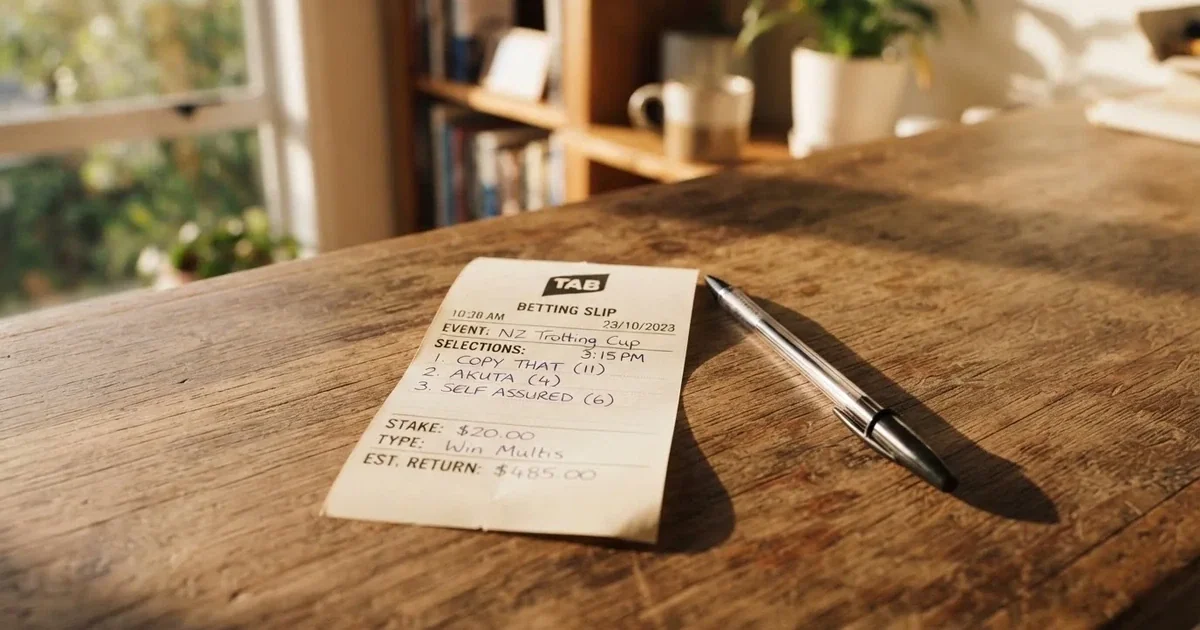
A sure bet is the fantasy every odds trader chases at some point: back every outcome of a match across two bookmakers, lock in a small profit no matter who wins, and walk away. The fantasy runs aground on three rocks, and each one costs the punter something real — a thin margin that demands a fat bankroll, bookmakers that close the moment they smell the technique, and a New Zealand market where only one group of brands may lawfully take your bets in the first place. This page is about those rocks, in that order, and the price each one charges.
Table of Contents
- The ten platforms on the shortlist
- What arbitrage betting actually is
- The law in New Zealand, plainly
- The maths that arbitrage betting actually costs
- Responsible gambling in a one-book market
- Crypto, anonymity, and what they change
- Strategy, predictions, and what “sure” actually means
- How odds work and what the margin tells the reader
- The two different “no” answers
- What the reader needs to know from this page
- Frequently asked questions
The ten platforms on the shortlist
A “top ten” for arbitrage betting in New Zealand is, by law, a top one. Since 28 June 2025 only TAB NZ and its sister brand Betcha may lawfully take online racing and sports bets from people in New Zealand. A technique that requires price differences across several bookmakers cannot be run inside that legal perimeter at all — two brands make an arbitrage book, not a market. The other eight names below are brands a New Zealand punter meets with, each named not because they are lawful here but because the comparison still tells the reader something useful: what offshore books offer, what they say about their own terms, and why none of it extends a New Zealand player’s protections.

TAB — the legal monopoly
TAB is the retail and online arm of TAB New Zealand, the statutory provider under the Racing Industry Act 2020. Section 74AAA, inserted by the Racing Industry Amendment Act 2025 and in force from 28 June 2025, names TAB NZ as the only operator that may offer racing betting, sports betting, or other racing or sports betting to a person in New Zealand, regardless of where that person resides or is incorporated. The Department of Internal Affairs told unlicensed providers serving New Zealand to withdraw with immediate effect on the same day the section came in. There is no licence register for betting because there is no licence to apply for — a structural oddity worth saying plainly, because “registered with the regulator” means nothing here in the way it does in the United Kingdom or Australia.
TAB publishes its app, “TAB – Racing & Sports Betting”, under the seller name New Zealand Racing Board; the app has been on the New Zealand App Store since 8 September 2014. Its rules cover fixed-odds and tote (pool) bets and name a long menu of bet types: Win, Place, Each Way, Quinella, Exacta, Trifecta, First Four, Double, Treble, Daily Double, Running Double, Quaddie, Big6, and Multis including Same Game Multis. Safer-gambling controls — deposit limits, time-outs and self-exclusion — are built into the app, and an exclusion set on TAB applies across the group’s other brand. The Problem Gambling Levy paid by TAB NZ funds harm minimisation and treatment; the gambling helpline 0800 654 655 and the text line 8006 sit on the app listing.

The monopoly is paired with a long-running operational partnership: Entain runs the TAB business under a 25-year agreement signed in 2023, taking a 50/50 share of gross profits with a floor of $150m a year going to TAB NZ for the first five years, plus a one-off $100m payment from Entain to the racing sector. For the punter this means modern sportsbook software with deep market coverage — TAB lists pre-match and live betting, racing, forecasts, boosted odds and a bet-builder — but no second lawful bookmaker to compare prices against. That is the binding constraint on every arbitrage line that follows.
Betcha — the social skin on the same licence
Betcha is the second of TAB NZ’s two online brands, sitting on the same section 74AAA permission. It is not a competitor to TAB; it is a different product wrapper around the same betting engine, aimed at a younger, mobile-first audience and built around community and content. The New Zealand App Store listing describes a daily Toolbox with odds boosts and insurance-style tools for bets that miss, a Bet Social section where punters chat, follow tipsters and share bets or pools, and a Playbook with tips and match analysis.
The point that matters for arbitrage: Betcha is the second brand on the same legal basis, not a second price source. Where TAB and Betcha differ on odds, that is internal product positioning rather than a separate market — and a punter who exploits that gap is trading against the same operator that holds his account, with the same closure risk that hangs over any arbitrage player. The “social” framing also brings a content risk worth naming: tipster copy is marketing, and a reader who follows it without checking the price is paying for someone else’s idea of a bet to land.
Glorion — not licensed in New Zealand
Glorion lists no licence that applies in New Zealand. The brand publishes only that support is available by live chat or email and that customers must be over 18. With no New Zealand regulator behind the brand, no New Zealand harm-minimisation framework reaches it, and the Department of Internal Affairs’ standing advice on offshore operators applies in full: minimal consumer safeguards in many of the jurisdictions these brands operate from, no obligation to return unspent credits, no obligation to pay out large wins.
For arbitrage specifically, the relevance is the negative: nothing in Glorion’s public terms puts it on a different pricing plane from TAB, because New Zealand players cannot lawfully place an arb that needs both books. A punt on Glorion is a punt outside the law, with no recourse to a New Zealand complaints body if the operator declines to pay.
BillyBets — not licensed in New Zealand
BillyBets offers decimal (2.00), American (+100) and fractional (1/1) odds side by side — a small detail that matters to arbitrage tools, since most calculators and finders ingest decimal odds. The brand also runs cashback and reload bonuses on sports, a coin shop where coins earned by depositing, betting, completing tournaments and challenges are exchanged for free bets and free spins, and a five-tier VIP programme.
The framing is the same as Glorion: a New Zealand resident betting with BillyBets is betting with an offshore operator that holds no New Zealand licence. The bonuses look generous in absolute terms — reload offers are reload offers — but a “bonus” outside the monopoly has no New Zealand backstop. The coin shop and the VIP ladder are also the kind of loyalty scheme that hardens a player’s account into a profile the operator can profile against an arbitrage screen, and once an account is profiled as an arb player the maximum wager shrinks and the promotions stop.
Roobet — not licensed in New Zealand
Roobet is a brand of Raw Entertainment B.V., registered at Korporaalweg 10, Curaçao, under Curaçao licence OGL/2024/687/0427. A Curaçao licence gives the brand no right to take bets from people in New Zealand; the New Zealand betting monopoly is governed by section 74AAA of the Racing Industry Act 2020, and that section does not care where the operator is licensed. Roobet is one of the better-known names in the crypto-friendly offshore space and publishes Bitcoin and other crypto support, which is why it appears on arbitrage screens in this market.
Two costs attach. First, New Zealand’s legal frame puts liability on the offshore operator, not the player, but the Department of Internal Affairs’ published warnings still apply: unspent credits may not be returned, large wins may not be paid, and there is no New Zealand complaints body. Second, Roobet’s scale means it has the in-house tooling to detect arbers quickly; its terms are the kind that pivot an arb account into a closed one with the stake confiscated on the way through.
22Bet — not licensed in New Zealand
22Bet takes single bets, accumulators, systems and chains, and offers live betting with real-time odds and score updates. It names a Curaçao licence (8048/JAZ) held by TechSolutions Group N.V., again with no reach into New Zealand. The product mix is wide — the kind of depth that produces the price variance an arbitrage bet needs in markets where such betting is lawful — but in New Zealand the wide product is the part you cannot legally use.
For an arbitrage comparison, 22Bet illustrates why the technique depends on the rest of the market: the books are individually priced to a margin, and a small spread across two books becomes the trader’s edge. In a monopoly that edge does not exist, because there is no second book to spread against.
Rabona — not licensed in New Zealand
Rabona launched on 23 December 2019 as the sixth sportsbook of the Soft2Bet group and is licensed in Curaçao, with no New Zealand reach. It offers the standard offshore sportsbook mix: pre-match and live betting across most mainstream sports, with bonus terms and VIP loyalty framing layered on top.
What an arbitrage reader expects from Rabona is the standard offshore offer shape: bonus-stacking, reload mechanics, and the kind of price update cadence that invites price-finding tools to scrape the feed. New Zealand players must not read any of that as lawful access — section 74AAA applies regardless of how cleanly the offshore book is run, and the Department of Internal Affairs’ standing warnings are the regulator’s own framing of the risk.
Golden Panda — not licensed in New Zealand
Golden Panda publishes dedicated Sports Terms and Conditions covering fixed-odds betting, Combo Bets, the Bet Builder feature, live scoreboards and broadcasts, and stake and odds limits. The brand names no licence that applies in New Zealand.
For the arbitrage reader, the value of a sportsbook is rarely the headline bonus — it is the depth of the markets and the speed of price updates, both of which Golden Panda’s terms gesture at without quantifying. The cost is the same as for the other offshore names: no New Zealand complaints route, no New Zealand harm-minimisation framework, and the risk that the operator acts on a profile flag and limits the account as it detects the pattern.
BetNinja — not licensed in New Zealand
BetNinja states that it is licensed to conduct online gaming operations by the Union of the Comoros. A Comoros licence gives no right to take bets from people in New Zealand, and section 74AAA of the Racing Industry Act 2020 still applies. The brand is a small operator in the offshore space and the relevant point for an arbitrage comparison is the standard one: a small book with thin margins on the mainstream events is rarely a price leader, and on the events where it is a price leader the limits are usually the first thing to trigger.
For a New Zealand player the licence geography is the deciding factor. A licence from the Union of the Comoros sits well outside the set of jurisdictions the Department of Internal Affairs treats as offering meaningful consumer protection for New Zealand residents, and the regulator’s standing warnings apply.
FunBet — not licensed in New Zealand
FunBet’s sportsbook offers odds on football, ice hockey, American football, basketball, volleyball, tennis, rugby and baseball, with live betting and a bookmaker described as open 24/7. The brand names no licence that applies in New Zealand. Rugby and 24/7 coverage are the parts of the offer most relevant to a New Zealand punter, since rugby union and rugby league sit at the centre of the local calendar (Super Rugby Pacific, All Blacks test matches, NRL).
FunBet is the final name on the shortlist because the rugby coverage is the closest match to what a New Zealand punter wants from a sportsbook. It is also the cleanest illustration of the trade-off the offshore angle always carries: the product looks like the right shape, and the law still says no.
What the shortlist actually says
| Brand | New Zealand status | What the operator’s own terms state |
|---|---|---|
| TAB | TAB NZ brand (statutory provider, section 74AAA) | Fixed-odds and tote bets, safer-gambling tools (deposit limits, time-outs, self-exclusion), New Zealand problem gambling levy funded |
| Betcha | TAB NZ brand (statutory provider, section 74AAA) | Daily Toolbox (boosts and insurance), Bet Social, Playbook; same New Zealand licence as TAB |
| Glorion | Not licensed in New Zealand | 18+ only, live chat and email support, no licence applicable here |
| BillyBets | Not licensed in New Zealand | Decimal, American and fractional odds; sports cashback and reload bonuses; coin shop; no legal standing in NZ |
| Roobet | Not licensed in New Zealand | Curaçao licence (OGL/2024/687/0427); crypto support; no NZ legal standing |
| 22Bet | Not licensed in New Zealand | Curaçao licence (8048/JAZ); singles, accumulators, systems, chains, live betting; no NZ legal standing |
| Rabona | Not licensed in New Zealand | Curaçao licence; standard Soft2Bet sportsbook mix; no NZ legal standing |
| Golden Panda | Not licensed in New Zealand | Dedicated Sports T&Cs (fixed-odds, Combo Bets, Bet Builder, live scoreboards, stake/odds limits); no NZ licence named |
| BetNinja | Not licensed in New Zealand | Comoros licence; no NZ legal standing |
| FunBet | Not licensed in New Zealand | Rugby and 24/7 live betting; no NZ licence named |
The column the table does not need is the one a reader is most likely to ask about: who pays the most on a given match. Two lines of odds from two different books is what an arbitrage bet needs, and in New Zealand that pair cannot both be lawful. The “what the operator’s own terms state” column matters precisely because it is what the reader can verify on the brand’s own site, not because any of those terms extends a New Zealand protection offshore.
What arbitrage betting actually is
Arbitrage betting — sometimes termed a “guaranteed trade” — exists because bookmakers form their own opinions on the probabilities of outcomes, and because those opinions sometimes disagree. Where two books price the three results of a football match such that one team’s win, the draw, and the other team’s win add up to more than 100% of the implied probability, no arb exists: the books have priced the market tighter than the punter can. Where the same three prices add up to less than 100%, the gap is the trader’s edge — small, and only after each price is multiplied by the stake needed to balance the books.
The mechanism is mechanical. An arb arises when the odds on all mutually exclusive outcomes of an event imply probabilities totalling less than one — when, in other words, the bookmakers’ prices leave room inside them. On a market priced at decimal odds of 2.10 on each side of a two-way event, the implied probabilities add to 1 ÷ 2.10 + 1 ÷ 2.10 = 0.9524, which is less than one. The 4.76% gap is the trader’s edge before the stakes are split. Once split, the punter collects his stake and a small profit on whichever outcome lands. Nothing about the trade depends on who wins.
The arithmetic that produces the price also produces the cost. A 2012 study by Franck, Verbeek and Nuesch, published as part of the academic literature on sports market efficiency, found that 98% of arbitrage opportunities return less than 1.2%. Less than 1.2% on the total stake across both bets, before any commission or before any bookmaker charges the trader. To clear $100 of profit on the average opportunity a punter must turn over roughly $8,300 of stake. To clear $1,000 the figure rises to about $83,000. The bankroll the technique needs is the first cost, and it is the cost the marketing never quotes.
Why the bankroll is so large
Three numbers make the bankroll unavoidable. First, the percentage edge is small: sub-1.2% is the rule, not the exception. Second, the bet must be placed on both sides before the price moves, and price moves in modern sportsbooks happen in seconds — a price that exists when the calculator runs may not exist when the punter clicks. Third, the books cap stakes on arb-friendly markets precisely because they know arbers are watching them, and once the cap is hit the second leg of the arb cannot be placed at the price the calculator saw.
The combined effect is a market where the bankroll demands are large and the time window for execution is short. A punter running arbs at $200 per opportunity clears roughly $2.40 per arb before the books react, and the books react by either closing the account, capping the stake, or voiding one of the legs after the fact. Volume is what clears anything meaningful, and volume is what gets the account closed.
What the books do about it
Bookmakers detect arbitrage betting quickly and treat it unfavourably. Maximum wager limits on arb-flagged accounts drop sharply — sometimes to a few dollars — and accounts have been closed with one leg of a placed arb cancelled on the way out. The historical record, including cases reported on the standard arbitrage forums and trackers, includes half-stake voidings where the operator returns the winning leg but keeps the stake on the losing leg, leaving the punter with a guaranteed loss. The 2012 study’s 1.2% average return is consequently the upper bound on a trader’s expected take before account restrictions are factored in.
In a market with a single lawful bookmaker the closure problem disappears by construction — there is only one book, and no arb is possible — and that is part of the design of the New Zealand monopoly. The bookmaker does not need to police arbers because the structure does not produce them.
The law in New Zealand, plainly
The law is short. The Racing Industry Act 2020 establishes TAB NZ as the sole provider of racing and sports betting in New Zealand. The Racing Industry Amendment Act 2025 inserted section 74AAA, which took effect on 28 June 2025: no person other than TAB NZ may offer racing betting, sports betting, or other racing or sports betting to a person in New Zealand, regardless of where that person is resident or incorporated. The Department of Internal Affairs told providers serving New Zealand to withdraw with immediate effect.
Three consequences follow for the punter.
First, there is no licensing route for another bookmaker and no licence register for betting, because there is only one lawful operator. The Gambling Commission does not issue betting licences; the Department of Internal Affairs does not maintain a register of approved sportsbooks. The shape of the New Zealand market is not a register with one brand on it — it is a section of an Act with one name in it.
Second, TAB and Betcha are the two lawful online brands of TAB NZ, run by Entain under a 25-year partnership signed in 2023. The two brands are one operator group, never rivals. Where one offers an odds boost the other does not, that is internal product split rather than a competing price, and a punter reading Betcha’s boosts as a separate market is reading product copy rather than market data.
Third, the law targets the operator, not the player. Section 19(4) of the Gambling Act 2003, inserted in 2025, says an individual may not be convicted for placing a bet with an offshore operator in breach of section 74AAA; no source states a penalty for a player. The Department of Internal Affairs’ published position is that players face the risks of unregulated markets — minimal consumer safeguards in many jurisdictions, no obligation to return unspent credits, no obligation to pay out large wins — without naming a player penalty. The right framing for a New Zealand punter is “TAB NZ and Betcha are the only lawful option, with New Zealand harm-minimisation tools and a complaints framework; offshore brands are not lawful for the operator and carry no New Zealand backstop.” Neither is the “safe choice” by default.
What may be bet on
TAB NZ takes fixed-odds and tote bets, and its published betting rules define the bet types it accepts: Win, Place, Each Way, Quinella, Exacta, Trifecta, First Four, Double, Treble, Daily Double, Running Double, Quaddie, Big6, and Multis including Same Game Multis. Live betting is listed in the TAB NZ apps; no statutory restriction on in-play markets has been published. No lawful New Zealand betting exchange exists and spread betting is outside TAB NZ’s sports-betting definition — so a New Zealand reader who wants a betting exchange is asking for a product the law does not provide. There is no statutory per-bet cap; limits are TAB NZ’s own terms. The ban covers events held inside and outside New Zealand.
Greyhound racing is closing in stages from 1 August 2026. From that date, offshore operators may not take bets on greyhound races either; the racing code is gone from the local calendar and from the offshore offering alongside it. Bets on politics and novelty markets are not established under the statute; virtual (computer-simulated) sport is treated by the 2026 online casino law as casino gambling rather than as sports betting. Whether esports is “sports betting” under the Racing Industry Act is not established.
Tax, payments, and player protection
For the player, Inland Revenue guidance is that recreational gambling winnings are generally not taxable, and prize money from TAB horse, dog and trotting races is not taxable; a person who bets as a business is a different case, and the general advice is to consult Inland Revenue or an accountant rather than to depend on a betting site’s tax summary. Operator-side, TAB NZ pays the Problem Gambling Levy of 0.74% (in force from 1 July 2025 to 30 June 2028), funding harm-minimisation work, and overseas operators supplying New Zealand residents pay online gambling duty (12% of profits since 1 July 2024, 16% from 1 January 2027) — but a duty being payable does not make an offer lawful. The point-of-consumption charge on offshore racing and sports bets ceased on 30 June 2026.
No statutory payment rule for betting accounts (card, bank, credit, prepaid, crypto) was found for New Zealand betting. TAB NZ’s deposit methods and limits are operator-level and come only from its terms; nothing generalises beyond what TAB NZ states. Account opening at TAB NZ requires a verified New Zealand address and ID — a step that the offshore books do not impose, and one that is the reason an arbitrage player using offshore books faces none of the address-verification friction TAB NZ requires. The Department of Internal Affairs has published no payment-blocking order or bank obligation. Nothing in the public frame states a rule on crypto or VPN use.
The age for TAB NZ betting is 18 — betting under 18 is an offence under section 89 of the Racing Industry Act 2020. Land-based casinos in New Zealand have a 20-year age threshold and the two limits are never merged. TAB NZ’s safer-gambling tools (deposit limits, time-outs, self-exclusion) apply across the TAB NZ group. There is no single national online-betting exclusion register — the register the 2026 online casino law will require is for online casinos only, and a self-excluded casino player is not automatically self-excluded from TAB NZ. Help is available on the free Gambling Helpline (0800 654 655, text 8006) and through Safer Gambling Aotearoa.
Advertising and what the reader sees
Because only TAB NZ may offer betting in New Zealand, the Department of Internal Affairs reads the prohibition as covering promoting or taking such bets for another operator; how DIA treats betting affiliates is not established. The Advertising Standards Authority’s Gambling Advertising Code applies to betting advertisements: ads must not target children (under 14) or young people (14 to under 18), judged by context, appeal and expected audience (25% or more counts as significant where accurate data exists), must not encourage harm, and must be truthful with terms available. There is no New Zealand equivalent of the UK “whistle-to-whistle” ban on betting advertising around live sport.
What that means for an arbitrage reader is that the marketing for Binance, online trading courses, and arb systems the reader meets with is not regulated as betting advertising and does not carry the Gambling Advertising Code’s standards. A “100% bonus” headline from an offshore book is the headline a reader needs to read with the code’s standard in mind, because the code does not apply offshore.
The maths that arbitrage betting actually costs
The arb is a margin trade. The edge comes from the gap between the sum of the implied probabilities of the outcomes and 100% — the gap is the trader’s take, before the bankroll is split across the legs. The gap is also the cost of doing the trade: a sub-1.2% edge means a sub-1.2% return on the total stake, and the stake is what the punter must have on hand to place the second bet at the price the calculator saw.
Take a two-way market priced at decimal odds of 1.90 on each side — an example, not a quoted price, and a price that produces a real arb because 1 ÷ 1.90 + 1 ÷ 1.90 = 1.0526, which is above 100% of implied probability and so is in fact a margin the bookmaker keeps, not an arb. The arithmetic is the point. The payout share of the market — what a balanced stake across both outcomes returns before any commission — is 1 ÷ (1 ÷ 1.90 + 1 ÷ 1.90) = 0.9524, and the bookmaker’s margin — what the bookmaker keeps of every dollar bet on this market — is 1 − 0.9524 = 0.0476, or 4.76%. A bookmaker priced both sides at 1.90 keeps 4.76% of the pool; a balanced bet on both sides loses the punter 4.76% of the stake.
This is the cost an arbitrage reader has to internalise before the percentages get quoted. The percentages that arbitrage traders celebrate are the gaps between the bookmaker margins of two books — the difference between a 4.76% book and a 4.50% book on the same event, which is the size of the trader’s edge. In a market with a single lawful book, the other book does not exist and the gap is zero. The trader’s edge in New Zealand, before any offshore book is consulted, is the edge within a single bookmaker’s pricing, and within a single bookmaker the edge does not exist.
A worked example, with the cost named
Suppose two offshore books price a two-way event at 2.10 on each side, an arb that returns about 4.76% to a balanced punter. A punter with $1,000 to deploy splits it across the two prices, collecting $1,047.60 plus his $1,000 stake back whichever outcome lands. He clears $47.60 on a $1,000 turnover, before any account restriction the books apply once they spot him.
To clear $1,000 on the same 4.76% arb the punter must turn over roughly $21,000 — the size of the bankroll the marketing never quotes. To clear $5,000 the figure rises to about $105,000. The “sure bet” stands apart from a salary only at volumes a single account cannot place without the books reacting, and at the volumes the books do not react to the edge is too small to clear a meaningful profit.
Now suppose the punter runs the same arb for six months, averaging a 4% realised return after fees, voided legs and stake adjustments. The expected profit on a $50,000 turnover is $2,000 — the cost of the punter’s time, the cost of the bankroll he has had to keep available for a price that may not exist when he clicks, and the cost of the days when the price moves between the calculator and the bet slip. The “sure” in “sure bet” is a description of the maths on a single trade, not of the trading account at the end of the year.
What “free bets” cost in this context
A free bet is what an arb trader uses to inflate his edge, because a free bet’s stake is not paid back with a win and so the trader can treat the free bet as a stake that costs him nothing if it loses. The maths: for a free bet at decimal odds of 2.10, the value of the free bet on a 4.76% margin market is the free bet amount × (2.10 − 1) ÷ 2.10 × (1 − 0.0476) = the free bet amount × 0.5000 × 0.9524 = the free bet amount × 0.4762.
A $100 free bet on that market is worth about $47.62 in expected value. A punter with a $100 free bet can deploy it on the side of the arb with the higher implied probability and lock in roughly $47.62 of expected profit on a trade where the loss side is his own cash. The free bet is the part of the trade that makes the maths interesting, and the free bet is also the part that the operator knows is being exploited — which is why free bets are usually restricted to one per customer, ring-fenced to a sportsbook market the operator has priced tightly, and excluded from the markets an arb trader prefers.
In New Zealand specifically, TAB NZ runs “bonus bets” promotions under its own terms; no New Zealand rule on bet-bonus size or wagering terms was found, so the cost of a TAB NZ bonus bet is whatever its terms say it is. The general rule — the cost of the operator’s generosity is paid in the markets the offer excludes and the stake limits the offer imposes — still applies.
The expected cost of clearing a bonus
The expected cost of clearing a bonus is the product of the required turnover and the margin of the market the punter is betting into. The required turnover is the bonus base (the bonus, or the bonus plus the deposit, as the offer states) multiplied by the wagering factor; the number of bets is the turnover divided by the stake per bet; the expected cost is the turnover multiplied by the margin of the market research names.
Take a 100% deposit match up to $100 with a 5x wagering factor on the bonus: the required turnover is $500. Placed at $10 per bet on a market with a 4.76% margin, the expected cost is $500 × 0.0476 = $23.80. The $100 bonus costs the punter $23.80 of expected stake to clear, and the cleared bonus is worth $100 in cash. The arithmetic inverts the marketing: a “100% bonus” is a $76.20 expected gift at the end of the clearing. A punter who reads the marketing as a $100 gift is reading it wrong; a punter who reads the marketing as a $23.80 expected cost is reading it right.
The number is an average, not a guarantee. Half of all punters clearing under the same conditions will clear at a smaller cost and half at a larger cost; the figure is the expected cost across many clears, not the cost of the next one. It is also a function of only the terms the operator publishes; a punter who ignores the time limit, the minimum price per bet, or the excluded markets finds the actual cost higher than the calculation suggests, sometimes by enough to wipe the bonus out entirely.
Responsible gambling in a one-book market
A monopoly changes what “responsible gambling” looks like for the punter, because the only bookmaker the punter can use is the only bookmaker that has a New Zealand harm-minimisation framework behind it. TAB NZ lists deposit limits, time-outs and self-exclusion in its apps; the New Zealand gambling helpline 0800 654 655 and the text line 8006 are on the app listing. The Problem Gambling Levy of 0.74% paid by TAB NZ funds harm-minimisation work, including the helpline and Safer Gambling Aotearoa.
The offshore books the reader meets with carry none of that. The Department of Internal Affairs’ standing position is that overseas operators may be in jurisdictions with minimal consumer safeguards, may not return unspent credits and may not pay out large wins — and the regulator’s published warnings to players are the regulator’s own framing of the offshore space. A punter who uses an offshore book for the price advantage that the law does not allow also uses a book without the harm-minimisation framework the law provides. The trade is the price for the absence of the framework.
The cost of the framework matters because the arb bettor’s pattern is a harm pattern by itself. He is logging into multiple accounts, chasing thin edges across bookmakers, escalating stake sizes when limits come down, and resetting with new accounts when accounts close. Each step is the kind of behaviour a self-exclusion or a deposit limit is designed to interrupt, and on the offshore books the interruption does not exist. On TAB NZ it does, and the punter who sets a TAB NZ deposit limit on the way into the technique is setting the limit a punter on the offshore books cannot set.
A punter who has decided that the technique is the route he wants to take has to set a hard deposit limit on TAB NZ before placing the first bet, decide the bankroll he is willing to lose on a sequence of arbs before he starts, and stop the moment the bankroll is down by the amount he set. The technique’s expected return is sub-1.2% on a good day, and a punter who runs it without those limits is paying the marketing the cost the marketing promises are free.
Crypto, anonymity, and what they change
Crypto deposits do not change the law. Section 74AAA of the Racing Industry Act 2020 names the operator, not the payment method; the prohibition applies regardless of how the stake reaches the bookmaker. A punter who holds NZD, BTC, ETH or USDT and routes any of them to an offshore book is still placing a bet with an offshore book serving a person in New Zealand, and the operator-side prohibition still applies.
Crypto changes the friction. A wallet-to-wallet transfer does not pass through a New Zealand bank, does not generate the same kind of transactional record a card deposit does, and does not name the recipient in the way an account-to-account transfer does. That is the source of the appeal — and also the source of the risk. A punter who values the friction’s absence is a punter who values a friction the operator also values, and a bookmaker who cannot identify the punter through the payment rail will identify him through the betting pattern, the IP address, and the device fingerprint. Anonymity at the deposit rail is not anonymity at the betting account.
For arbitrage specifically, crypto’s relevance is the same as for any other technique. Crypto-friendly books price markets the same way fiat books do, run the same margin, and apply the same account restrictions once the pattern flags. A punter who deposits in BTC and arbs in BTC is paying the same margin and clearing the same restrictions as a punter who deposits in NZD. The crypto part is the marketing; the betting part is the cost.
What crypto does not do is substitute for a New Zealand licence. The law names the operator; the payment method does not bring the operator inside the law.
Strategy, predictions, and what “sure” actually means
“Sure” in the arbitrage context is a description of the trade, not a description of the trading account. The maths gives a sub-1.2% edge on 98% of opportunities, the books restrict the stake on the rest, and the punter’s bankroll is the limit on how much of that edge he can actually clear before the books react. A reader who reads the marketing as a guaranteed income is reading the promotion; a reader who reads it as a low-margin trading technique on a regulated market is reading the maths.
A prediction-based system — a model that prices outcomes and finds mispricings to bet into — is a different technique with a different cost. The model is the work; the betting is the execution. A model that produces a positive expected return on a set of prices the bookmakers are slow to update is a model that produces the same kind of edge the arb does, with the same kind of stake requirements and the same kind of account restrictions. The two techniques share a cost structure because they share an edge structure.
Statistical arbitrage in sports betting is the academic framing of the same idea. The 2012 study by Franck, Verbeek and Nuesch is the canonical citation; the headline figure is the 1.2% average return; the conclusion the authors drew is that the opportunities are real, small, and competed away by traders with bankrolls and execution speeds the average punter does not have. A New Zealand punter reading that conclusion has to read it as the upper bound on what the technique is worth in a market that includes only TAB and BET — where “competed away” is structural rather than competitive.
The honest strategy for a reader who has decided that the technique is what he wants is the unglamorous one: pick the lawful bookmaker (TAB NZ or Betcha), set a deposit limit before the first bet, run a sequence of arbs against the lawful bookmaker’s pricing and accept that the edge inside a single book is zero, and stop the moment the bankroll is down by the limit he set on the way in. The technique’s expected return in New Zealand is the cost of the technique, and the cost is paid in the bankroll the punter must keep available for a price that may not exist when he clicks.
How odds work and what the margin tells the reader
Decimal odds are the price the punter pays and the return the punter gets. A decimal odd of 2.10 means a $1 stake returns $2.10 if it wins, including the $1 stake. The punter’s profit on a winning $1 stake at 2.10 is $2.10 − $1 = $1.10; the punter’s loss on a losing $1 stake at 2.10 is $1. The two together — profit on the win, loss on the miss — produce the book’s margin.
The implied probability on a decimal odd of 2.10 is 1 ÷ 2.10 = 0.4762, or 47.62%. The implied probability on the other side at the same price is also 47.62%, and the two together add to 95.24%. The 4.76% gap is the book’s margin: out of every dollar a balanced punter wagers on the two sides, the book keeps 4.76 cents. The payout share — what a balanced punter collects on every dollar wagered — is 1 − 0.0476 = 0.9524, or 95.24%.
This is the number an arbitrage reader needs to monitor on every price. A book that prices both sides of a two-way event at 2.10 is a 4.76% margin book; a book that prices the same event at 1.95 / 1.95 is a 2.56% margin book; a book that prices it at 1.90 / 1.90 is a 5.26% margin book. The lower the margin, the larger the punter’s take on a balanced bet, and the harder the book is to find because low margins mean tighter competition among books. The higher the margin, the smaller the punter’s take on a balanced bet, and the easier the book is to find because loose pricing is a marketing tool.
The arb itself is the gap between two books’ margins on the same event. A book that prices a side at 2.10 (implied probability 47.62%) and another book that prices the same side at 2.20 (implied probability 45.45%) leaves a 2.17% gap between the two books’ views, and a balanced punter using both books clears the gap as profit. The gap is the trader’s edge; the trader’s edge is also the trader’s turnover, because a 2.17% edge on a $1,000 stake is $21.70, and the punter’s bankroll is what he has to keep available to place the second leg at the price the calculator saw.
Reading a price in a one-book market
In a one-book market the second book does not exist, so the price a TAB NZ customer sees is the only price he can bet at. The implied probability of any TAB NZ price is the price the punter pays for the book’s view of the outcome; the implied probability on the other side of the same event at the same bookmaker is the implied probability of the other outcomes; and the sum of the implied probabilities on all outcomes is the book’s margin plus 100%. The punter can read the margin from the prices and read the prices from the margin, and that is the trade-off: the price is the cost, and there is no second price to compare it against.
The honest read of a TAB NZ price is the honest read of any price: a 1.90 / 1.90 / 4.00 (three-way) market on a football match implies probabilities of 52.63%, 52.63% and 25.00%, which sum to 130.26%, which means the bookmaker is paying out 1 ÷ 1.3026 = 76.77% of every dollar wagered and keeping 23.23% as margin. A 23.23% margin is a wide margin for a mainstream football match — mainstream markets on Premier League, A-League and Champions League fixtures tend to run in the 2–5% margin band — and the wide margin is the cost a one-book market charges the punter for the absence of competition.
The two different “no” answers
There are two “no”s a reader will meet on this page and they are not the same.
The first no is the legal no. Offshore bookmakers are not licensed in New Zealand. TAB NZ and Betcha are the only lawful online betting brands for people in New Zealand. The legal no is the no the regulator states and the law backs; a punter who reads the legal no and bets offshore anyway is reading the law and betting against it.
The second no is the practical no. A one-book market is a market without arbitrage. The arbs the reader finds on an odds-tracking screen are arbs between offshore books; in New Zealand the second book of that arb is unlawful. A punter who runs the arbs anyway runs them across two unlawful books, with the offshore books’ account restrictions and the regulator’s standing warnings on his head.
The honest answer to “is arbitrage betting possible in New Zealand” is both no’s at once: not lawfully, and not in the form the technique requires. The technique is a trade on a multi-book market, and the New Zealand market is a one-book market by design.
What the reader needs to know from this page
Three points, in the order the reader meets them.
First, the law. TAB NZ and Betcha are the only lawful options; everything else is offshore, unregulated for New Zealand purposes, and outside the harm-minimisation framework the law provides. A reader who accepts the legal no accepts the one-book market the law creates.
Second, the maths. The edge on 98% of arbs is below 1.2% of stake; the bankroll required to clear meaningful profit from that edge is in the tens of thousands; the books restrict the stake on the rest. The marketing promotes a guaranteed trade; the maths promises a small return on a large stake.
Third, the cost. The bookmaker’s margin sits inside every price, and the smaller the margin the harder the book is to find. A New Zealand punter has no choice of margin because the market is a one-book market, and the cost of that absence is the margin TAB NZ prices. A punter who reads the margin from the price has read the trade.
Frequently asked questions
Does sports arbitrage betting actually work?
Yes — in markets where the law allows several bookmakers to compete. The mechanics are sound: when two books disagree on the probabilities of the outcomes, a balanced bet on both sides clears a profit no matter who wins. The catch is the size of that profit, which the academic literature puts below 1.2% on 98% of opportunities, and the size of the bankroll required to make the percentage meaningful, which is in the tens of thousands of dollars of available stake.
How does someone place an arbitrage bet?
The process is mechanical: find an event whose outcomes have decimal odds at two different books that imply probabilities summing to less than 1; split the bankroll across the outcomes in proportion to the implied probabilities; place both bets before the price moves; collect whichever leg wins. Each step has a cost: the calculator’s edge erodes with time, the second leg may not be available at the price the calculator saw, and the books restrict the stake once the pattern flags.
Can arbitrage betting be done from New Zealand?
Not lawfully with two licensed operators. Since 28 June 2025 only TAB NZ and Betcha may take online racing and sports bets from people in New Zealand; offshore books serving New Zealand residents are breaking the law, and a New Zealand punter using them carries the standing warnings the Department of Internal Affairs publishes. The technique is also a poor fit for the one-book market that remains, because the second price the technique requires does not exist.
Which bookmaker may lawfully take sports and racing bets in New Zealand?
TAB and Betcha, the two online brands of TAB New Zealand, under section 74AAA of the Racing Industry Act 2020, in force from 28 June 2025. Entain runs the TAB business under a 25-year partnership signed in 2023. There is no licence register for bookmakers because there is no licence to apply for; the shape of the New Zealand market is a section of an Act, not a register with one name on it.
How is the return on a bet worked out from the stake and the odds?
For a single bet at decimal odds, the return is the stake multiplied by the odds and the net profit is the stake multiplied by (odds minus 1). For a multi, the odds of the legs multiply into one price before the stake is applied. A $10 stake at 2.50 returns $25 and produces a $15 net profit if it wins; a $10 stake on a two-leg multi with legs at 1.80 and 2.20 (combined odds 3.96) returns $39.60 and produces a $29.60 net profit if both legs win.
What is the bookmaker’s margin and how is it seen in the odds?
The margin is what the bookmaker keeps of every dollar wagered on it; the payout share is what it pays out. For a market whose odds on every outcome imply probabilities summing to S, the payout share is 1 ÷ S and the margin is 1 − (1 ÷ S). A two-way market priced 1.90 / 1.90 implies probabilities summing to 1.0526, a payout share of 0.9524 and a margin of 4.76%. A three-way market priced 2.10 / 3.40 / 3.60 implies probabilities summing to 1.0606, a payout share of 0.9427 and a margin of 5.73%. Lower margin means a larger punter share; in New Zealand’s one-book structure there is no second margin to compare.
Written by the editors at Nztennisodds.